

This post is part of a series in which I explores some of the ways I am working to embrace my blindness and integrate it into my identity. I am finding it helpful to unpack and articulate different aspects of my vision disability and how it shapes the way I interact with the world around me. I’m hoping this exercise will help clarify my thinking as well as build understanding and empathy with members of the blind and visually impaired community.
I have always loved walking in the woods. There’s nothing like taking to a secluded trail to escape the bustle and stress of our frantic world. The fresh air in my lungs, birdsong in my ear, and swishing leaves beneath my feet can work wonders for my anxious soul. Like many people, I find clarity, peace, and communion with God in nature.
I am grateful for the many opportunities afforded to me to explore the great outdoors. Growing up in northern Maine, my family enjoyed hiking trails in Baxter State Park. At the beginning of college, I was part of a 12-day wilderness adventure in the Adirondack Mountains. These days, my expeditions are shorter and tamer, consisting mostly of brisk walks with our dog on local trails and wilderness reservations.
Recently, I wrote about navigating stairs as a person with low vision. In this space, I would like to consider how my limited vision impacts how I go hiking and the mechanisms I use to compensate for my lack of sight.
Finding my way on the trail

When I was in college, I would sometimes get lost wandering the criss-crossing paths adjacent to the school. This was unsettling the first few times it happened, but soon I figured out some reliable ways to help me retrace my steps back to campus. I have continued to use these techniques in my woodland treks ever since.
- Taking note of visual landmarks: A knotted tree, a pointed boulder, a part of the trail that wraps around a pond — markers like these help me get my bearings as long as I am careful to notice and commit them to memory. I tend to get lost in thought during long solo walks. When this happens, I stop paying attention to my vision beyond what is necessary to stay on my current path. More than a few times, this has led to Wrong turns, dead ends, and almost bumping into unexpected obstacles (or people). Waking from my reveries can be disorienting and annoying. I often feel stupid for not paying attention to where I was going. These feelings diminish when I can recall the landmarks that can guide me home.
- Underbrush marking trail boundaries: When hiking in the forest, I sometimes see false paths leading off into the trees, beckoning me to follow. This is especially likely when I’m looking for a turn onto another trail and feeling nervous that I might have missed it. When I venture onto one of these “mirage trails,” I will typically realize my error when the underbrush gets thicker which makes forward progress more challenging. I can then do an about-face and return to the actual trail.
- Others often know the way: When another person or party approaches or passes by, they often help to keep or get me back on track. Sometimes I’ll ask for directions, but if I’m off in my own daydreamy world, I will usually follow at a distance. Either way, I really appreciate the assistance.
Ascending the hill
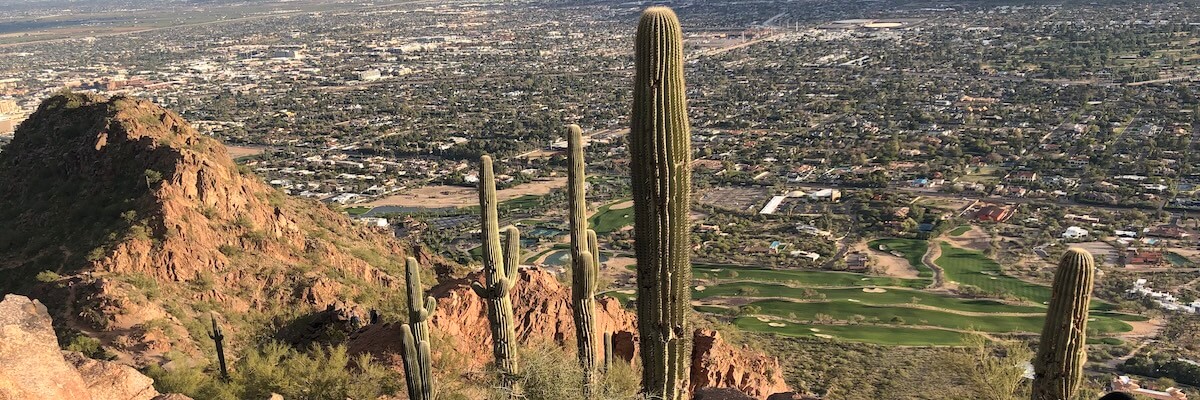
Several years ago, I took one of my children to Phoenix, Arizona. One of the highlights of our trip was climbing Camelback Mountain just outside of the city center. Although Camelback’s summit is not too high, it’s a steep scramble up the barren face past outcropping boulders, scraggly trees, and beautiful saguaro cacti. While my kid scampered up the trail in front of me, my chubby middle-aged body struggled and huffed trying to keep pace. I had to stop multiple times, not only to catch my breath, but also to refocus my eyesight, which I’m prone to ignore during intense physical exertion.
Hiking uphill is much easier for me than going down. There’s not as much depth perception required, but I still need to pay close attention to each step to maintain my balance and avoid tripping. There are a few strategies I’ve developed over the years to help with this.
- Stepping high: When climbing up or over obstacles, I will often lift my foot higher than is necessary to reach the next level or clear the hurdle. This is because I can’t completely trust my eyes to correctly gauge the distance of my next stride. I’ve stumbled and fallen far too many times to leave this to my limited sight. I may look like I’m marching up the hill, but in reality, I’m working to assure solid footing and keep from stubbing my toes.
- Looking for flat surfaces: Working out my next step is always a point of intense focus when I traverse uneven terrain. Even though I can usually perceive slopes and distances as they rise up in front of me, assuring my footing is sure takes unwavering diligence. I need to find the flattest surface that my outstretched foot can reach and will fit on. This means that I am usually looking down at the ground ahead of me as opposed to the views around me as I climb.
- No walking stick: It may seem like a walking stick would help me keep my balance and gauge distances, but I have found the opposite to be true. I actually find a walking stick to be cumbersome and distracting. I need to keep my focus on forging the best way ahead, but a stick demands some of that attention to move it through tight spaces and prevent it from bumping into things. Trying to measure distance with a stick is also frustrating, as my limited depth perception makes it hard to tell how far it is between the end of the stick and the next step. It’s like having to manage a rigid third leg that doesn’t bend, and it just slows me down.
- Keeping my eyes turned on: Active and steady seeing takes sustained concentration. As I mentioned, I have a propensity to “shut off” my vision when I’m under significant mental or physical strain. Since climbing mountains entails both of these, I often find it necessary to slow down or stop to reawaken my eyes. Despite my coping mechanisms, my limited vision remains very important for this activity.
Going down, down, down
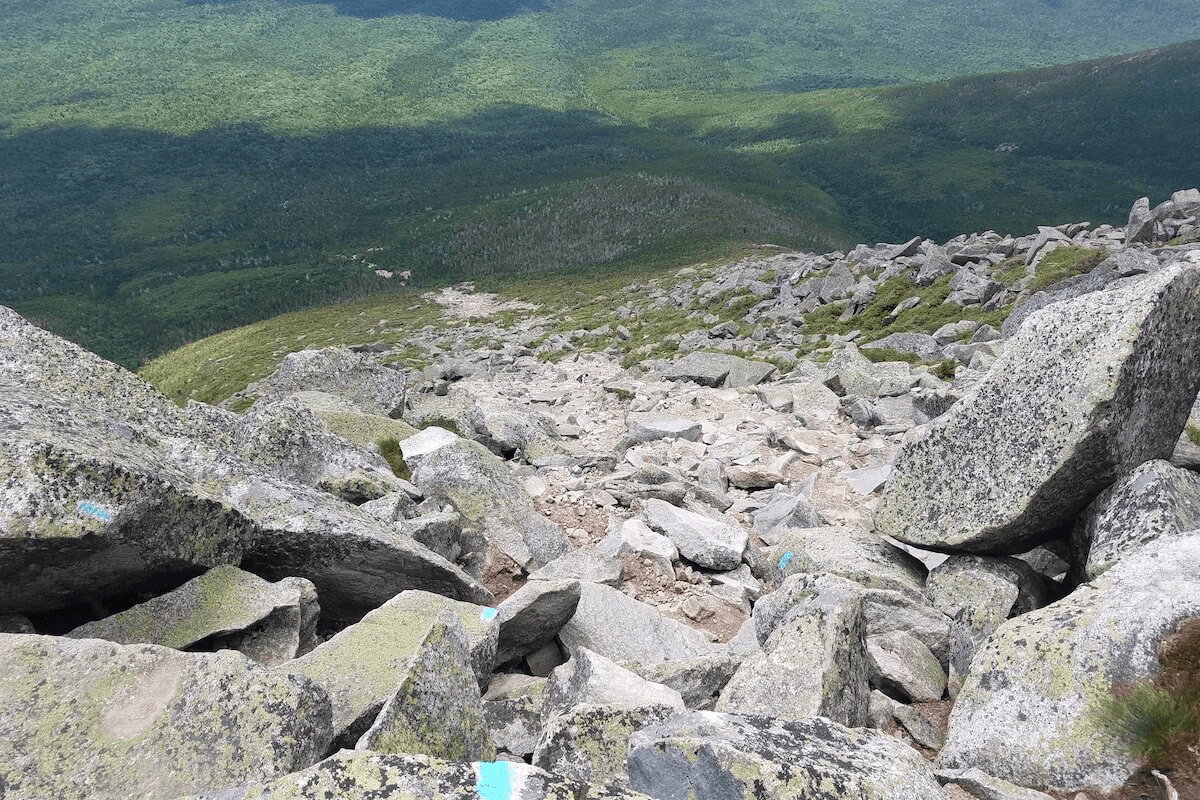
One sunny summer day, my dad took my three younger siblings and me to climb Mount Katahdin, the northernmost point of the Appalachian Trail and the highest peak in Maine. This wasn’t my first time scaling Katahdin, but it turned out to be the most memorable one because of the trail we took to come down the mile-high mountain. My father chose to lead us straight down Abol Trail, the steepest and most direct route to the bottom. And I do mean straight down. Abol was formed by a rockslide ages ago, and its sheer boulder-strewn face is austere and unrelenting. You can see the trees at the foot of the trail from the top.
Landslides and instability prompted the closure of the original Abol Trail in 2016 in favor of a slightly longer more forgiving, though still arduous, route. But my family’s hike took place at the dawn of the nineties, so we descended the old trail.
If climbing up is challenging with little depth perception, how can a blind guy manage the trip down such a steep incline?
- Follow the feet of the person in front of you: This is the strategy I rely on most when going down uneven surfaces, whether they are shallow or near-vertical. If the descent is steep, I will ask someone to walk in front of me and stay close enough to me that I can watch their feet and mimic their steps. There’s no substitute for this moving blueprint when I can’t gauge how far down the next rock is from my current position.
- Keep my hands free: As I mentioned, I don’t like using a walking stick. On the contrary, I prefer to have both of my hands available to grab ahold of rocks and branches to steady myself, slow me down, and keep me from falling.
- Balancing with a backpack: Carrying a pack requires that I adjust my balance to account for the weight of its contents. This is fairly manageable when climbing upward because I am generally leaning forward slightly with my knees bent (to facilitate my high-stepping) during an ascent. It’s a different story going downhill when I need to shift my weight and posture frequently to resist gravity’s accelerating pull while weaving through obstacles. The backpack adds another variable with its contents shuffling and sliding around as I squat, bend, and hop my way down. The good news is that a backpack is usually lighter climbing down a mountain because a good deal of its supplies have already been used on the trip up.
- Feeling my way down: Sometimes I just need to reach ahead with my foot until it touches the next level surface. I prefer to stay standing while doing this, but if the drop is more than a couple feet, I may have to kneel or sit down to reach the landing below.
- Stopping to rest and relax: I spend a great deal of physical, mental, and emotional energy to maintain visual focus on feet, rocks, branches while making my way down. This is tiring and frustrating, particularly when I misstep, trip, or scrape my knee. I have to remember to stop, breathe, and recenter on a regular basis.
Despite the challenges inherent to low-vision hiking, it remains one of my favorite activities. The capacity to explore the world independently is incredibly freeing and fulfilling to someone with a disability. I hope to continue enjoying this freedom for many years to come.
Did you find this exposition interesting or helpful? Do you have a question about how people with vision disabilities navigate and interact with the world?
More Blind Sight articles
 Blind Sight: How a guy with low vision navigates stairs Navigating stairs with minimal depth perception can be complicated, but employing creative and sometimes non-visual coping strategies and context clues can be a big help.
 Blind Sight: How to practice piano when you can’t see sheet music How do blind people learn to play piano? Here are some reflections on a few of the methods I have used to thrive as a pianist with low vision.
 Blind Sight: More on how a blind guy learns to play piano Additional thoughts on how blind people can become proficient at playing the piano.
 Blind Sight: Why did the blind guy cross the road? I am legally blind, and I live near a busy intersection near Boston. I don't typically use a cane to get around familiar places, but this intersection is still challenging when drivers don't observe the walk signals. I wondered if anything might change if I used my cane. Here's what happened.
 Blind Sight: The Pride Behind the Pride, a Thank-You to Those Who Dance with Us July is Disability Pride Month—a time to honor the experiences, rights, and dignity of people with disabilities. This month, many of us assert our identities, share our stories, and push for change in a world not yet built with us in mind. But today, I want to use this moment to shine a light in a different direction.
I found this post and your others in this series enlightening. Rest assured that even those of us whose vision can be corrected to 20/20 with glasses still miss the views while concentrating on difficult or steep slopes, use landmarks on return trips, and end up on false trails. I took many solo hikes during COVID and ended up lost or off trail several times. On the webs of interconnected trails in the Fells, I’ve often used the position of the sun to get headed back in the right direction. But obviously that strategy falls short on cloudy days!