
Several weeks ago, I shared some thoughts on how blind people can learn to play piano without reading sheet music. There are several more techniques that helped me become proficient on the piano as someone with low vision. After some conversations arising from the previous article, I’m posting these here with the hopes that both students and teachers may find them useful.
Putting theory into practice
Memorizing music, playing by ear, and improvising enabled me to learn and play music without being able to sightread it. Putting these methods together worked pretty well for me, and coming out of high school, I had some unrefined ideas in my head about how chords and keys fit together, though I wasn’t able to put them into words very well.
Studying music theory in college supercharged these skills. It was like learning the words to a language I already sort of understood but didn’t know how to articulate. Assigning names and definitions to the rough concepts I had collected revealed how dynamic and interconnected they were.
For instance, I already knew that when playing in the key of C major, the notes G, B, D, and F together formed a chord that naturally pulled toward a C chord. My piano teacher had told me this was called a dominant seventh, but that really didn’t mean much to me because I couldn’t see how it impacted the music I wanted to play (mostly video game themes).
In my music theory courses, we analyzed more than just the notes themselves. We looked at how they built upon and interacted with each other in the context of hymns, pop songs, and piano sonatas, extracting patterns that we could hunt for in other pieces of music. As I became comfortable with this intricate backdrop, I realized why a dominant seventh chord worked the way it did. When I saw one, I had a pretty good idea of what chords might have led to it, and which ones would probably follow.
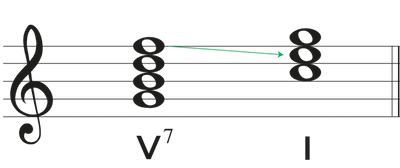
On top of this, there was shorthand that encapsulated these complexities. I could write the text "V7" to succinctly capture the essence of a dominant seventh chord with just a Roman numeral and a digit. This was immensely powerful as it worked regardless of whatever key a piece was in. It was also visually accessible to me, as I could read a large print "V7" on the fly in a way I had never been able to do with the corresponding notes on a staff. And even when I couldn’t see the chord symbol, I learned its sonic characteristics and how to anticipate and optimize them in songs, including ones I was hearing or playing for the very first time. This kind of musical understanding and appreciation didn’t need to come through a printed score, and it was wonderfully life-giving.
Making it up as I go
I was very young when I started "formally" composing my own songs. I remember playing one of my earliest pieces entitled "Animals on Parade" at my very first piano recital, the left hand walking a marching bass line with big triumphant chords bouncing along above it. My original songs were constant companions as I learned the piano.
Once I had a solid foundation in musical theory, composition became faster and more fun. I often felt like the right chords would spring into being just in time for an unfolding melody line. I could explore these creations fully in my mind and get audible feedback and reminders by playing them on the piano. I didn’t really need to unpack visual representations, although that could be useful too.
During my college music theory courses, I applied the concepts I was learning to hymn reharmonizations and original songs I played in church services. It was incredibly valuable to put newly encountered musical devices into practice right away, as doing so gave me working examples that I could reuse, experiment with, and improve upon as I wrote new pieces.
Feeling the notes
The sense of touch is very instructive when learning the piano. Black keys are arranged in sets of two or three, with each pair or trio separated by a two white notes. This means that each key has a distinctive physical shape to its scale and chords. Playing in the key of C major, which is comprised of all white keys, feels very different to one’s fingers than playing in its immediate neighbor B major, a key that is also rooted on a white note but also includes all the black keys. These variations provide helpful points of reference that facilitate navigating the keyboard without having to look at it.
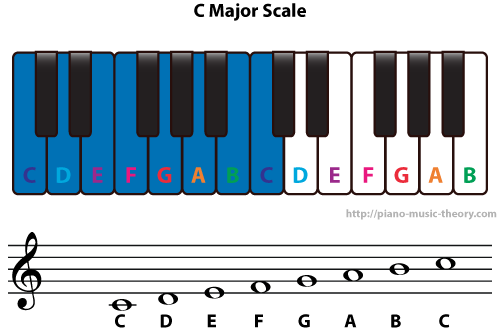
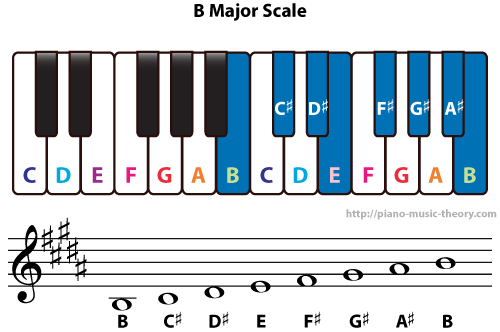
Recently, I was asked to play piano for Andrew Peterson’s beautiful piece "Is He Worthy" for a concert at my church. The song features wide walking broken chords in the left-hand which require most musicians (including me) to lift and shift their palm to span the large intervals between the top and bottom notes. I already knew the piece in its original key of B major, and so I was surprised when I struggled to play it transposed up a half step to C major. The source of my troubles was the different shapes of the large intervals in the left hand. In B major, it’s easy to feel the relative position of the notes in these chords because they include both white and black keys. However, in C major with its scale of identically spaced and shaped white keys, these tactile markers are not present. I needed to concentrate on moving my hand the exact distance between the notes to play the song in this new key, and it took more practice than I anticipated to adjust my muscle memory accordingly.
In addition to the piano itself, there are toys and other tactile piano learning aids available to help students literally get the feel of the keys. After publishing my previous post on this topic, I followed up with the piano teacher who helped inspire these posts. She told me excitedly how one of her blind students was making great progress using a piano puzzle she ordered for him. Touching the notes and assembling them into the shape of a keyboard is giving him a whole new way of learning about the piano.
Conclusion
Effective learning encourages seeking out different ways to experience the material being studied. Multi-sensory perspectives and different mental frameworks can be very helpful to learners with disabilities. Piano lessons are no exception. Sheet music may be one of the primary ways to communicate information, but this in no way prevents blind students for learning with other means like playing by ear, improvisation, understanding the physical layout of the keyboard, and a good working knowledge of musical theory. In my experience, your imagination and creativity are the only limits to your ability to learn to play piano.
More Blind Sight articles
 Blind Sight: The Pride Behind the Pride, a Thank-You to Those Who Dance with Us July is Disability Pride Month—a time to honor the experiences, rights, and dignity of people with disabilities. This month, many of us assert our identities, share our stories, and push for change in a world not yet built with us in mind. But today, I want to use this moment to shine a light in a different direction.
 Blind Sight: Why did the blind guy cross the road? I am legally blind, and I live near a busy intersection near Boston. I don't typically use a cane to get around familiar places, but this intersection is still challenging when drivers don't observe the walk signals. I wondered if anything might change if I used my cane. Here's what happened.
 Blind Sight: How to practice piano when you can’t see sheet music How do blind people learn to play piano? Here are some reflections on a few of the methods I have used to thrive as a pianist with low vision.