Last month, my family traveled to the high country of Colorado. As we stepped off the plane and made our way through the airport, I started noticing the effects of the thinner air of the Mile High City of Denver on my body. I felt a bit light-headed and more easily winded as we walked toward the rental car pickup area. I had anticipated these challenges while acclimating to the altitude, but there was something else I didn’t expect.
I had to work harder to see.
This was alarming. I needed to concentrate more to read street signs and shop names. Noticing and navigating stairs, rises, and dips in front of me as I walked required additional focus. Objects in the distance were more difficult to make out. This was irritating as I normally operate on low vision, but it was doubly frustrating because I didn’t understand the cause of the sudden deterioration of my eyesight.
Gradually, I began to recognize a close connection between the physical effects of the thinner air on my body and my decreased visual acuity. Under normal circumstances, I continuously spend a small amount of physical and mental energy to focus my eyes on what I am looking at, reading, or trying to bring into focus. However, during intense physical exercise, I subconsciously “turn down” my eyesight to redirect this energy to my body’s increased demands. Over the first couple days in the high country, I realized that my body’s increased effort to get enough oxygen from the thin Colorado air was causing me to unknowingly reroute my “visual energy” away from my eyes.
My environment had caused a significant change in my visual impairment. This type of fluctuation is not uncommon for people who live with disabilities.
Disability is “zigzaggy” and variable
In my experience, disability is dynamic, changing in severity and impact depending on time, environment, and many other circumstances. Disability is a spectrum, and my position on it is not fixed. Most of the time, I don’t need to use assistive devices or technology to make my way around places I know. I’m familiar with the layout of my home, neighborhood, workplace, and church, and I have enough vision to navigate these locations unaided. However, I didn’t hesitate to unfold and use my white cane as my family moved across the expanse of the Denver airport to board our flight home. Besides helping to compensate for the impact of the thinner air on my vision, the cane alerted people in the bustling crowd around us that I might need a bit more space and time to find my way.
Using my cane in some contexts and not others does not mean my blindness is any more or less valid in certain situations. It is simply an indicator of the dynamic nature of disability.
Dr. Ashley Shew, amputee and author of Against Technoablism, lives with dynamic disability every day. In this clip from her interview on the Factually! with Adam Covnover podcast, she talks about how “a lot of disabilities are “zigzaggy” and variable, and a lot of our representations are really static.
How many spoons do you have today?
Spoon theory is a metaphor that helps describe how much physical or mental energy a person has for daily activities. This shorthand can be useful for people with chronic pain, illness, or disability to estimate and communicate their relative stamina and limitations. Spoon allotments fluctuate from day to day, and “spoonies,” as members of the chronic illness community sometimes affectionately call themselves, need to be careful on how they spend their finite supply of spoons.
“We always count spoons to make sure we don’t go over our ration for the day, because we cannot get anymore.” writes disabled scholar and disability activist Dr. Amy Kenny, author of My Body is Not a Prayer Request. “If we are out of spoons, we crash. There is no silverware drawer for us. We cannot save our spoons for ladle. We cannot borrow from tomorrow’s spoons today.”
“We need to recast our bodies as gardens, and not as machines,” Kenny asserts. Unlike our cars, we cannot take our bodies to the repair shop to replace a worn out or broken part with a brand new one, no matter how much science fiction and modern medicine try to convince us otherwise. Instead, we can do our best to eat well, exercise, and reduce stress to create good conditions for a healthy body. However, just like a well-tended garden, whose ultimate success is dependent upon external factors like temperature, sunlight, and moisture, our bodies are also shaped by aging, illness, the need for sleep, and other elements beyond our control. Spoonies understand that our bodies, like gardens, “change with the seasons and require regular rest to restore the land.”
Situational disability is also dynamic
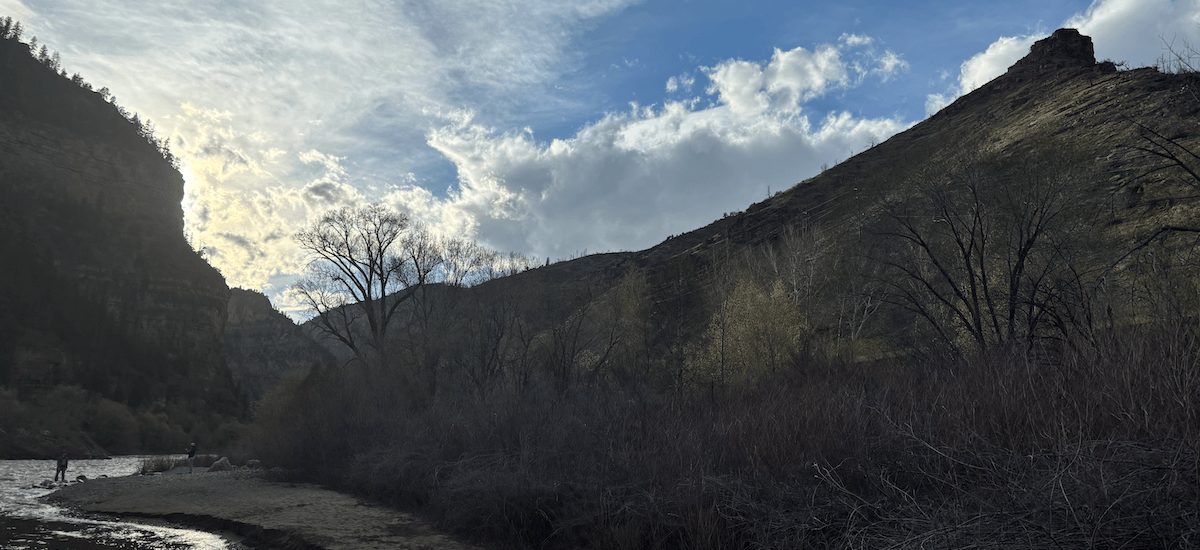
Regardless of whether you count spoons, we all have not-so-good days when our bodies and minds place more restrictions on us than we would like. WE all experience situational disabilities like fatigue, stress, and distractedness that make everyday activities more challenging. And these situational disabilities also vary depending on context. Trying to read your phone in the direct noonday summer sun on a beach with no shade will likely be different from doing so in the mountain twilight on the Colorado River (where the featured image for this article was captured). Yet both situations probably involve squinting to decipher washed-out text in the glare of the sun. The situational disability is the same; only the conditions are different.
Logan International Airport in Boston is at sea level, and when my family’s return flight from Colorado touched down there, I was relieved to find that I could once again both breathe and see without extra effort. My “normal” vision had returned, and with it, a deepened appreciation for how nuanced and un-static disability is, and will always be, in our ever-changing world.