

I think it’s time for a shift in mindset.
The Merriam-Webster dictionary defines “disability” as “a physical, mental, cognitive, or developmental condition that impairs, interferes with, or limits a person’s ability to engage in certain tasks or actions or participate in typical daily activities and interactions.” Unless we live with one of these impairments in ourselves or those closest to us, it is tempting to see disability as peripheral to our lives.
But is that really the case?
Understanding the scope of disability
Here are some interesting statistics.
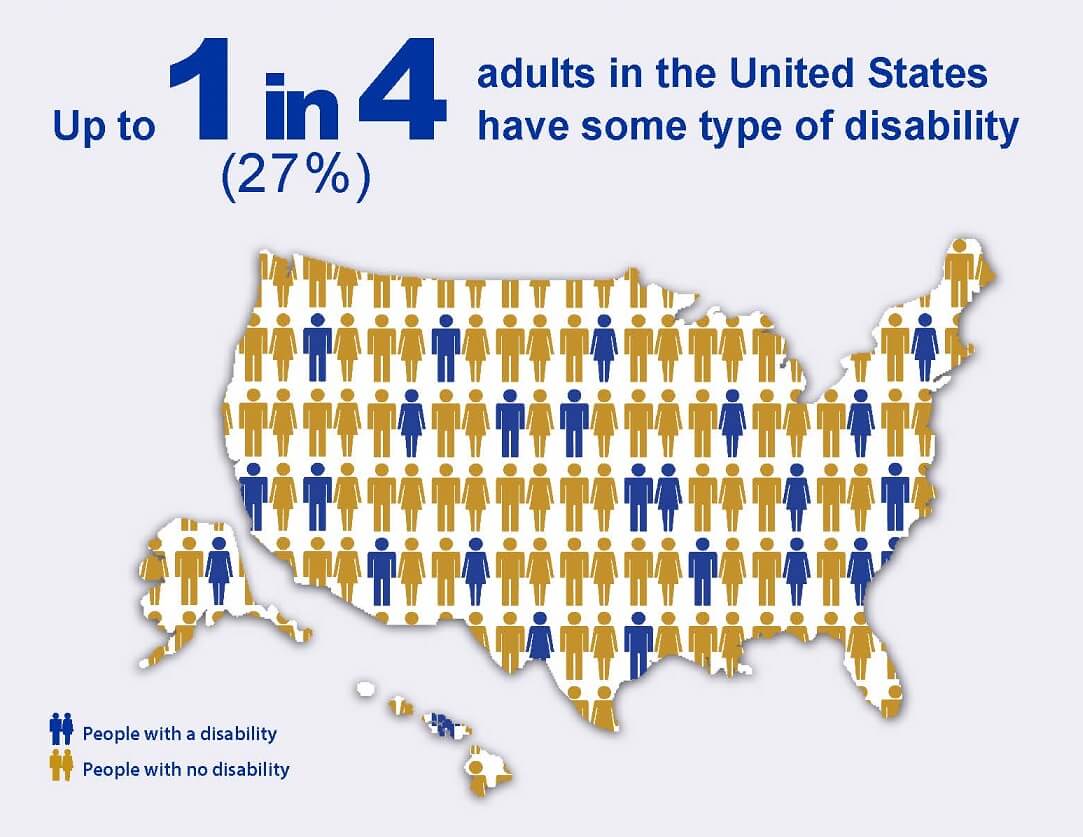
- According to the Center for Disease Control and Prevention, 1 in 4 (27%) of adults in the United States have some form of disability
- The World Health Organization (WHO) states that 1.3 billion people in the world (16% of humans) “experience significant disability.”
- The likelihood and severity of permanent disability increases with age, and the WHO also reports that in 2020, 1 billion people were 60 years of age or older. The pace of population aging is accelerating faster than in the past, and this number is projected to increase to 1.4 billion in 2030, and 2.1 billion in 2050.
This almost certainly means that every one of us or someone we love experiences a significant disability, whether we are aware of it or not.
Expanding our definition of disability
Disability is not limited to blindness, deafness, and other permanent or semi-permanent conditions that may come to mind when we hear the term. The Microsoft Inclusive Design initiative published an infographic that depicts different levels of disability and their impacts on our senses. Here is one variation of this diagram.

Here is the data from the graphic in tabular form in case you cannot see the image.
| Sense | Permanent | Temporary | Situational |
|---|---|---|---|
| Touch | One arm | Arm injury | New parent holding an infant in one arm |
| Hear | Deaf | Ear infection | Bartender listening in an noisy room |
| See | Blind | Cataract | Distracted driver looking out the side window |
| Speak | Non-verbal | Laryngitis | Speaking with a heavy accent |
The point is that even if we do not live with a permanent disability, each of us has most likely experienced a temporary disability due to illness or injury. We also navigate situational disabilities every day. Maybe you are dealing with one right now (i.e. if you are reading this article in bright sunlight).
Dispelling the stigma of disability
The word “disabled” often carries a negative connotation. It can evoke feelings of awkwardness, pity, and otherness. This is unfair to people experiencing disability and detrimental to society as a whole. In addition, it’s also a fundamental misunderstanding of the term itself.
Disability advocate Lawrence Carter-Long explored the linguistic origins of the word “disabled” in a popular Facebook post.
In its most literal sense, the prefix “dis” is not a synonym for “un” or “in” as is commonly and mistakenly assumed. It is much broader, bolder and more robust than that. So, you might ask, what does “dis” mean? In classical Latin, the primary meaning of the prefix “dis” translates to “two ways, in twain,” according to the Oxford English Dictionary. Twain literally means “in different directions, apart, asunder.” Use of the prefix in this way has given us perfectly good words like “discern,” “discuss,” “dismiss,” “dissent” and “distill.”
Carter-Long asserts that when understood in this context, there’s nothing negative about being “disabled.” In fact, it reframes disability as an opportunity for creativity, on-the-fly innovation, and unique positive expression. “The occurrence of disability, by design, opens up space for discovery, discernment and disruption.”
Every one of us experiences this truth whenever we walk on a curb-cut, put on a pair of glasses, listen to an audiobook, or use a computer keyboard. These are technologies invented by and for disabled people. We all experience ability “in different directions,” and this is beneficial for everybody.
Conclusion
Let’s free ourselves from faulty, insular, and prejudiced views of disability. “Disability is part of being human and is integral to the human experience.”. It is normal. Disability is about you and me. It is part of each one of our stories, and that is a profoundly good thing.
What role does disability play in your life?