At Pedal Point Solutions, we believe that accessibility is strongest when it’s informed by lived experience and built through collaboration. Over the past few months, I’ve had the privilege of working alongside DeAnn Elliott through the Massachusetts Commission for the Blind’s (MCB) internship program—a statewide initiative that pairs blind professionals with organizations committed to inclusive employment. DeAnn is the founder of Insite Access, an accessibility testing company known for its precision, attention to detail, and user-centered focus. In this Q&A, she shares her journey, insights on digital accessibility, and reflections from our time working together.
Getting to Know DeAnn
Can you tell us a bit about your background and what led you to start Insite Access?
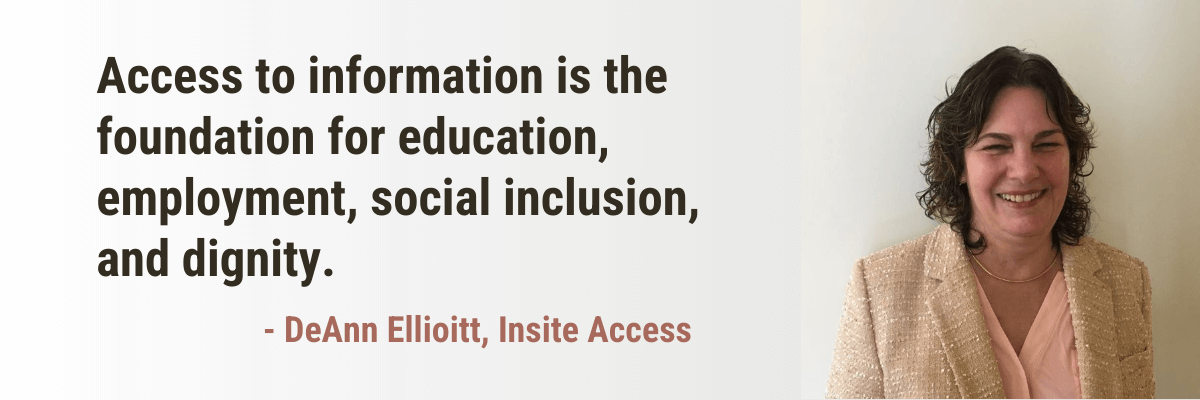
Sure–thanks for the chance to chat. Like your business, mine is an outgrowth of my life experience. After college, I worked as a college administrator for a dozen years, and loved helping students reach their goals. It was during that time that I was diagnosed with Retinitis Pigmentosa, an eye condition that gradually leads to blindness. As my vision changed, I became persuaded that access to information is the foundation for education, employment, social inclusion, and dignity.
The 1990s were, of course, amazing years. It started with the passage of the Americans with Disabilities Act in 1990, shortly after my diagnosis, and then the internet was invented a few years after that. When I lost the ability to read hardcopy print, I could still read by downloading talking books. When I stopped driving, I could get around with a cell phone and navigational apps. I became a daily user of assistive technology, and it was almost seamless, like when one door closes, another one opens. So I became a big believer in the power of technology to even the playing field.
What drew you to accessibility testing as a profession?
By the time I became legally blind, I was a stay-at-home wife and mom. The internet was one of my most powerful parenting tools, but I sometimes had trouble making it work. I’ll never forget the frustration of not being able to read an online school lunch menu because of the way the table was formatted, or having a master’s degree and needing to wait for my mother to help me order school uniforms because the images didn’t have text descriptions. It was sobering to realize that there was no gizmo I could buy or trick I could learn to get around some of these accessibility issues, because they were the result of the way the website was coded.
As it turned out, my then-husband was a software engineer who spent the dot com boom years starting and flipping high tech startups. I didn’t see myself as entrepreneurial, but it was empowering to see how technology was something that real people made; not bureaucrats in distant board rooms, but smart, creative friends at our dining room table who also worked in the tech field and who were excited about making change happen.
Ten years later, divorced and an empty nester, I wanted to influence the habits of web developers, among other things, so I became involved in advocacy through several disability organizations. It didn’t hurt that my boyfriend was an assistive technology trainer who was also blind.
Back then, I think I had a sort of naive view that if I and others could just inform web developers that their code wasn’t working for us blind folks, they’d change it right away. After all, we know that when something works for users with disabilities, it generally improves the user experience for all users, and one can make a really compelling business case for greater accessibility. What’s not to love? But of course, there were other market forces at work, and while there were some successes to be sure, making change happen was going to take more time.
My involvement led back to higher ed, to a part-time job at Harvard University in the User Research Center, where I reviewed websites and provided feedback to developers about accessibility bugs. Whenever I revisited webpages I’d reviewed and saw the University had fixed some issues I’d helped identify, I was elated. It was a different way to help students reach their goals.
The position ended with the COVID emergency, but my supervisor encouraged me to become an independent contractor–something I’d never considered. So I started Insite Access during the time I was at home. I provide freelance, remote manual web accessibility testing to organizations who are interested in making their websites work better for users with disabilities.
Experience with the MCB Internship Program
How did you first get involved with the Massachusetts Commission for the Blind internship program?
When I became legally blind 20 years ago, I was fortunate to receive great training from MCB. In my experience, when medical science can do no more, good rehabilitation training, supportive friends and family, and screen reading software are almost as good as a cure.
MCB has been there for me over the years as my eyesight and employment needs have changed. I thought I wouldn’t be eligible for an internship because most internships are for students, but when I learned I could work one-on-one with a web developer, I was excited to give it a try.
What has your internship experience with Pedal Point Solutions been like so far?
I’m enjoying the collaboration! I think you and I have complementary skill sets. I don’t write code, for instance, and I know you’ve been working as a web developer for about 25 years, so having the opportunity to ask you questions helps me understand some of the bugs we’re finding. And getting your feedback about the way a web developer likes to have the findings presented has helped me develop better reporting tools and techniques that I’ll be able to use in other situations.
What skills or insights have you gained through this partnership?
I’ve practiced using some new video editing software I bought to document findings, and I learned how to do beta testing with the TestFlight app on pre-release applications that will be used on Apple devices. I think maybe I’m getting a little faster mapping bugs to the Web Content Accessibility Guidelines.
It’s also been nice to see that I really enjoy it. I get instant gratification out of finding bugs, and when I can sit at my desk and work remotely on my own schedule, and connect weekly by Zoom and feel like I’m making a small contribution to a larger project, I’m in my happy place. It’s been fun, and it feels like I’m on the right track.
How has working with another blind professional shaped your approach to accessibility?
Starting a small business was new for me, and I’ve benefitted from sharing strategies. For instance, the service I used to buy my company’s domain name wasn’t super accessible, and you recommended an accessible one that you use for your LLC, so I switched. I like the email address you use, and I’m working to get a dot com address for my business, too.
I was developing some contracts and was happy to introduce you to my attorney. There are so many steps one needs to take to get things up and running, and there can be accessibility challenges along the way, so swapping tips and tricks has been really helpful.
Can you describe a moment during your internship that made you feel especially empowered or proud?
On the most recent project we’ve been working on, the site owners have a good idea they’re trying to bring to market, and their website covers all the basics. I respect that many developers need to prioritize those issues that can cause legal trouble, and there may be little time or budget for other changes.
With this project, I sense that you and this client are open to secondary findings, which is my favorite kind of project. You might remember they had a process for returning an item, and the process was initiated by filling out an online form that was technically accessible. Unfortunately, The return process involved several steps, such as having the customer take a photo with their telephone’s camera, upload the photo, fill out a hardcopy mailing address label, and send the item back to the company .
For customers with disabilities, not only blindness, some of these steps could be challenging because it involved seeing through a camera’s viewfinder, using assistive technology to manage digital images non-visually, holding a pen, reading one’s own handwriting, and possibly driving to the post office. Since a positive user experience is often as much about usability as it is about technical accessibility, I enjoy the opportunity to have those kinds of conversations.
On Accessibility and Assistive Tech
What’s your go-to assistive technology setup for testing websites?
JAWS 2025 and Windows 11 with Google Chrome on a Hewlett Packard laptop. Earmuff headphones are optional.
What’s one accessibility barrier you see far too often—and what would you say to developers who overlook it?
I agree with WebAIM’s annual surveys, showing that insufficient color contrast, images without alternative text, and things like that are alive and well. But I’m not sure that enough organizations appreciate the impression those findings on their website create.
Imagine the CEO of a company sending out a hardcopy letter to their customers and shareholders on letterhead stationery. It has the company logo at the top and contains important information. Now imagine it also contains half a dozen grammatical errors and typos. It’s written in several fonts, with so little contrast that recipients struggle to read it. It’s not a good look! And if it happened repeatedly, it probably wouldn’t promote the company’s brand as effectively as they’d like.
Yet there are websites that we’ve visit with screen readers that look a bit like one of those letters. Some accessibility issues are relatively easy to identify and address, and I think their presence on a website can signal to customers who use assistive technology that the company hasn’t taken some rather preliminary steps to address them.
When we consider that we’ll be celebrating the 35th anniversary of the Americans with Disabilities Act next month, and the internet is nearly as old, we’re seeing enough companies who are getting it right that the ones who aren’t engaging with accessibility are beginning to stand out in contrast.
There’s a large number of baby boomers who are entering retirement and aging into vision loss, and they’ve been using the internet throughout their working lives. They want to continue to do business with the companies they’ve been loyal to for years, even if they’re now doing it with assistive technology. Having even a modest, sustained commitment to accessibility can be a good investment.
Are there accessibility features or solutions you wish more companies knew about?
I’m a big fan of accessibility statements because I think they’re a great way to improves communication between companies and their customers. To do anything these days, from taking a class to paying a bill or making a dinner reservation, we all need reasonably unfettered access to the internet. But few web developers have the lived experience with vision loss that you have, so they’re writing code based on other things, like what works for them, or what works for most of their customers, or maybe what seems best based on what they learned in college, and they may not be fully aware of the consequences of their design preferences and coding choices.
In my view, more companies would benefit from creating a relatively easy way for customers with disabilities to report an accessibility concern. Without an accessibility statement, companies are leaving free technical feedback from knowledge experts on the table!
Building a Business in Accessibility
How are you growing Insite Access, and what are your current goals for the business?
I just upgraded to an LLC this spring, and my immediate goal is to continue to develop the infrastructure to support the work. I’m hoping to add a certification or two over the next year.
What’s been the biggest challenge of running your own business as a blind entrepreneur—and the biggest reward?
The learning curve has probably been the biggest challenge. I was a Liberal Arts major in college, so I needed to learn the difference between a sole proprietorship, an LLC, a corporation, and so forth. What forms do I need? Where do I file them? How do I pay taxes?
I’ve been surprised to discover, though, how many people have started their own small business, and even if they closed it 25 years ago, a lot of people are happy to talk about it, or muse about what worked well for them and what they might have done differently. I think the biggest reward has been the chance to pull together my various life experiences, and work with other people to do something I like that hopefully makes a difference, and maybe a little income.
Any tips for other blind professionals who want to get into the accessibility field?
If you have the privilege of taking your time, don’t try to do too much too soon. The work is out there, and when you’re ready, it will still be there.
Collaborating and Looking Ahead
How do you think the field of digital accessibility is evolving—and what gives you hope?
I’m looking forward to the implementation of the European Accessibility Act later this month. I’m hoping that will drive accessibility here in the U.S. too, in companies that want to do business in Europe. And I think AI offers the potential to be a great tool for web developers to write accessible code.
What’s something you learned from working with Simon and Pedal Point Solutions?
I’ve learned new reviewing techniques, made new contacts, understand better what a “live region” is, and learned how to identify a song that has a “pedal point,” which was a new musical term for me!
What makes for a great working relationship in accessibility?
Curiosity, a willingness to learn, good communication.
Quickfire / Fun Questions
Screen reader of choice: go!
JAWS, though I have a lot of appreciation for NVDA, and I’d be lost without VoiceOver on my phone.
Most satisfying bug you’ve ever found?
Probably the time when my kiddo was graduating from college, and commencement was remote due to COVID. We were all participating in the ceremony from our dining room, and I wanted to order some big, embarrassing posters from the university that said, Proud parent of a graduate”, but I couldn’t make the online form work.
I called the school, and they asked me to check the webpage again in about half an hour. Sure enough, they’d fixed it, and I got my posters. I wish everyone was that responsive!
One accessibility myth you’d love to bust forever?
As you’re aware, the number of accessibility lawsuits against private businesses has been growing over the last 15 years. I find it really challenging to read articles about plaintiffs with disabilities “targeting” businesses in a “flood” of litigation. In my view, these statements are overly simplistic, fuel an inaccurate narrative about the motives of people with disabilities, and obscure the actual reasons for the litigation.
While I don’t doubt there are a few people who are trying to take advantage for personal financial gain, it isn’t at all representative of what I’ve experienced. I see litigation as a last resort, and I hope that businesses like yours and mine can be bridges between companies and their customers.
Working with DeAnn has been an energizing reminder that accessibility isn’t just about compliance—it’s about connection, creativity, and opening doors for others. Whether we were swapping testing techniques, uncovering issues with HTML tables, or dreaming up ways to grow our businesses, I learned a lot from DeAnn’s perspective and presence. If you’re a business or developer wondering what true inclusion looks like, take a cue from DeAnn: start with empathy, stay curious, and never underestimate the power of lived expertise.