
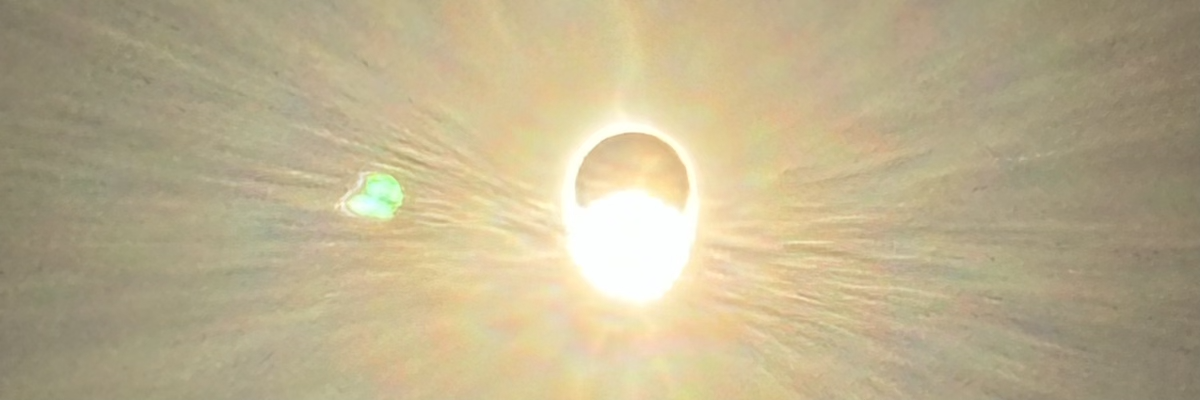
A couple days ago my family made the last-minute decision to drive five hours to my parents’ house. My folks live in northern Maine, which just happened to be in the direct path of today’s solar eclipse, called the path of totality, where the moon completely obscures the sun. It’s like God was scheduled to use the moon as a ball-point pen to scratch a jet-black line across our continent and right through my hometown. We didn’t want to miss this event, as there won’t be another one like it in America for 20 years.
I had read that a total solar eclipse is a profoundly multi-sensory experience, and this added to my excitement of being in the center of the moon’s shadow, or umbra, for this phenomenon. "A total solar eclipse is so much more than something you just see with your eyes. It’s something you experience with your whole body," claimed astronomer David Barren in a recent NPR interview. I wanted to see if this was actually true.
I was not disappointed.
Low vision for everybody
The duration of the entire eclipse was about two and a half hours. The initial 70 minutes of the event consisted of a slow fadeout of the mid-afternoon light as the moon passed in front of the sun. This gradual dimming was funky, but nothing compared to the five minutes leading up to the brief period of total solar obstruction. During these few moments, the darkening accelerated as the landscape all around me quickly plunged through twilight to deep dusk. With every blink, my eyes strained to adjust to the disappearing light. But it wasn’t just me; those around me also commented how their eyesight struggled to keep pace with the evaporating daylight.
A visual, sonic, and tactile masterpiece
The onset of the total eclipse was sudden and visually breathtaking. The blue sky rolled back in all directions to reveal the vast expanse beyond. The southwest horizon was rimmed with an eerie yellow glow, the illusion of a vanishing sunset that should never happen at that point of the compass. The sun collapsed into a blurry ball of flickering white light. I could not perceive the impeding moon at its center with my naked eyes, but it was easily visible to me through my smartphone’s magnifier.
But vision was only one component of this experience. As the sunlight failed, a collective cry of amazement rose and fell from those near me and a larger group of spectators I couldn’t see about half a mile away. A blanket of quiet awe settled over the landscape near and far as the whole world drew its breath.
The temperature dropped, and the light breeze that had tickled my cheek throughout the warm spring day became a chilling gust. I was glad to have donned my winter coat a few moments before.
I found my heart flip-flopping between the thrill that accompanied the fullness of this moment and the austere stillness that covered all creation. I felt infinitesimal, yet not insignificant, humbly privileged to experience this once-in-a-generation wonder.
And then it was over. The moment passed, and the moon abruptly stripped itself from the sun. Light cascaded onto the stunned earth, and the world exhaled the breath it held for the past two minutes. The sights and sounds of a northern spring afternoon recalibrated their regular rhythm. My reeling mind and senses slowly calmed, leaving behind an afterglow of this profound and unforgettable experience.
Inclusive marvels of nature
For me, the total solar eclipse was something I experienced as a complete person, immersing my full body and soul into its grandeur. It was deeply moving, and completely accessible to disabled and abled alike.
In my lingering reverie, I find myself enumerating other natural phenomenon that can powerfully engage people with disabilities. I asked my family about this on our drive home, and we came up with this list.
- Waterfalls
- Thunderstorms
- The ocean forces like waves, tides, and under toe
- River rapids
- Mountaintops
- Strong guests of wind
- The deep forest
In the wake of today’s eclipse, I want to seek out more of the full body experiences our natural world has to offer. And I want to find ways to help others with disabilities do the same.
What are some other inherently inclusive wonders of nature?